

KORTH RANGER CONVERTIBLE 9MM/.38/.357 REVOLVER
By: Massad Ayoob
A prestige product at a prestige price, Korth is where mechanical precision meets brute strength
It used to be that if you wanted the most prestigious .357 Magnum revolver, your choices were the Colt Python or the Smith & Wesson Model 27, each of them the deluxe flagship of their manufacturer’s product fleet, and each relatively expensive. Today, the “luxury .357s” come from Europe, as is the case with the subject of this article, the Korth from Germany. They are imported into the USA by Nighthawk Custom in Arkansas. By the way, Korth (of courth!) is actually pronounced “Court” by Europeans and longtime Korth fans, while Yanks tend to pronounce it the way it reads.
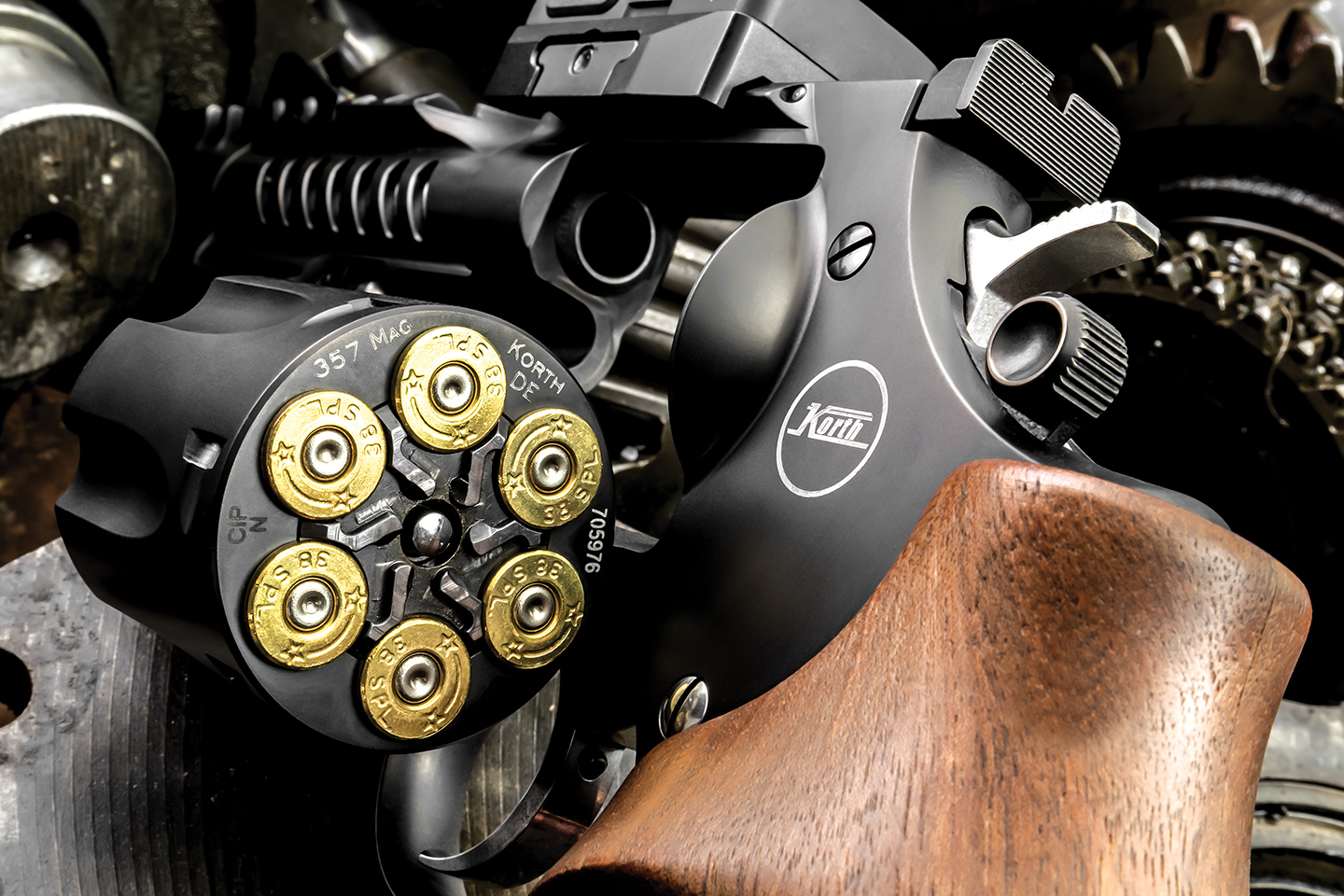
Our test sample was impressive out of the box. If you’re accustomed to Yank revolvers, it will take a bit of getting used to. The cylinder release is a knobbed lever on the left side of the frame, alongside the hammer. Push it forward and push the cylinder out, an almost effortless movement. I found the .38/.357 cylinder would take the L-frame size Safariland Comp III speedloaders I used in years past to win state and regional Stock Service Revolver championships in IDPA with the Ruger GP100 and the S&W 686. Korth’s own speedloaders go for $60.
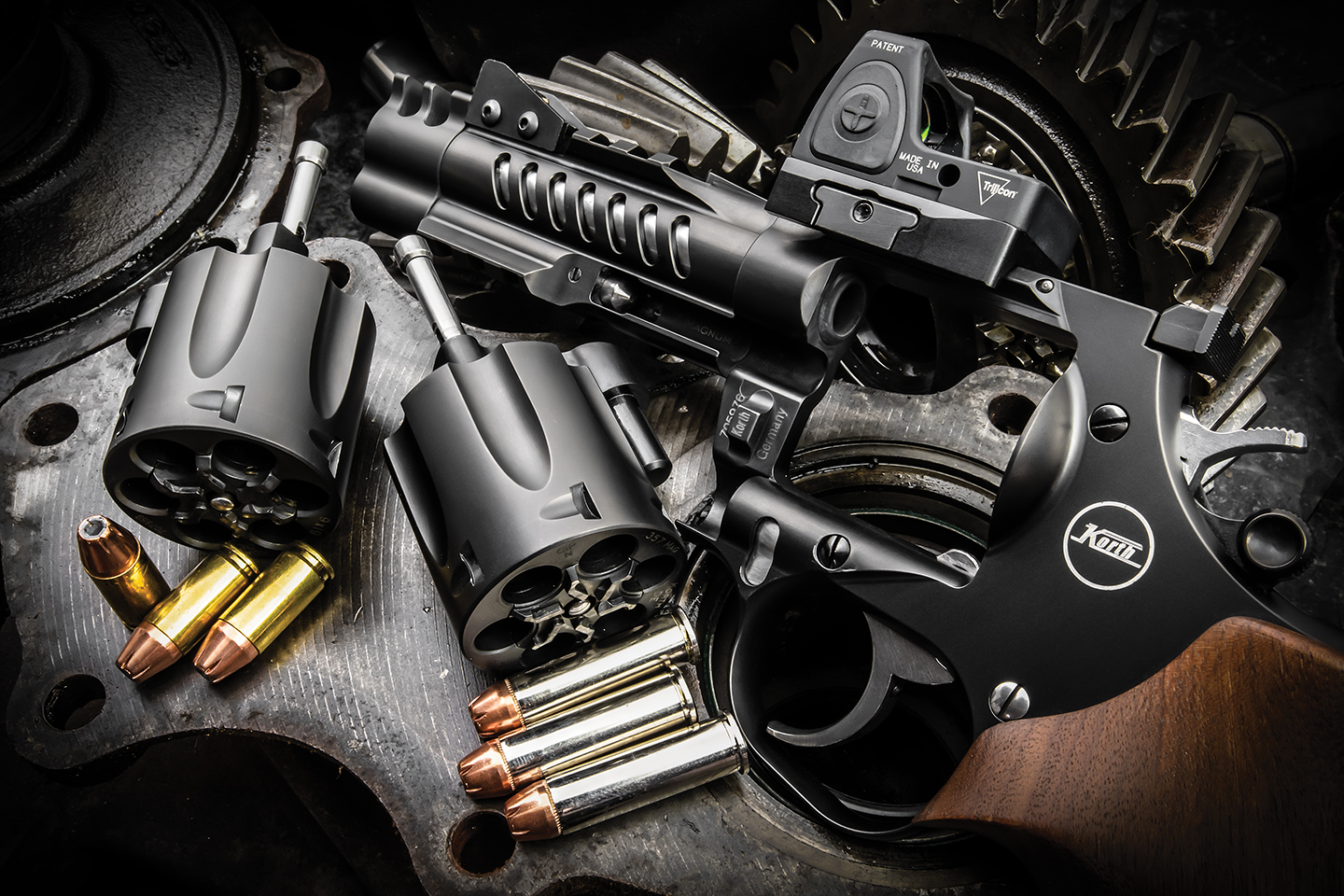
The next difference you notice between this Korth and the American prestige .357s is the finish. It’s a modern, workmanlike DLC coating, not the highly polished Bright Blue of a Model 27 nor the Royal Blue of a Python. Built for “go,” not “show.”
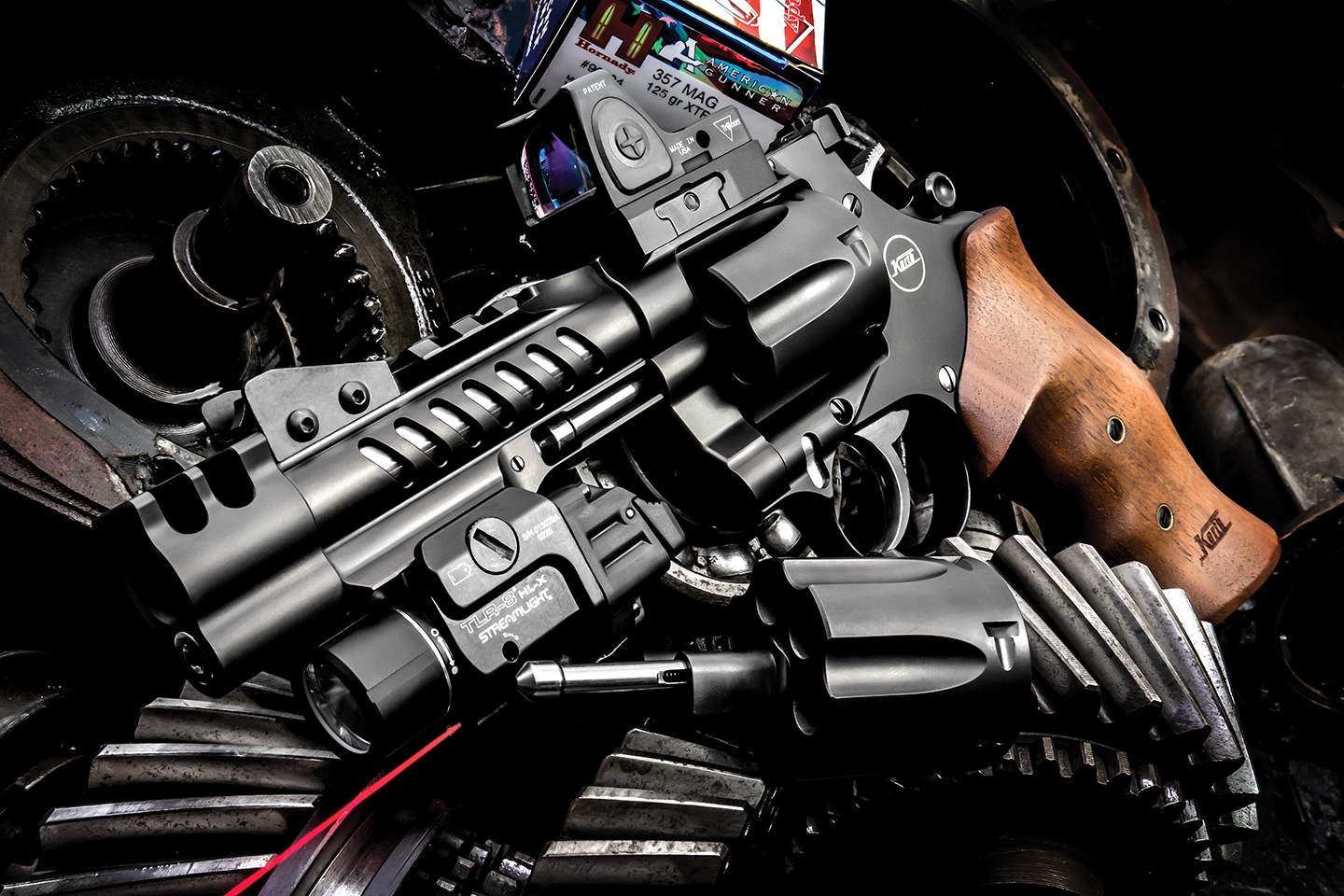
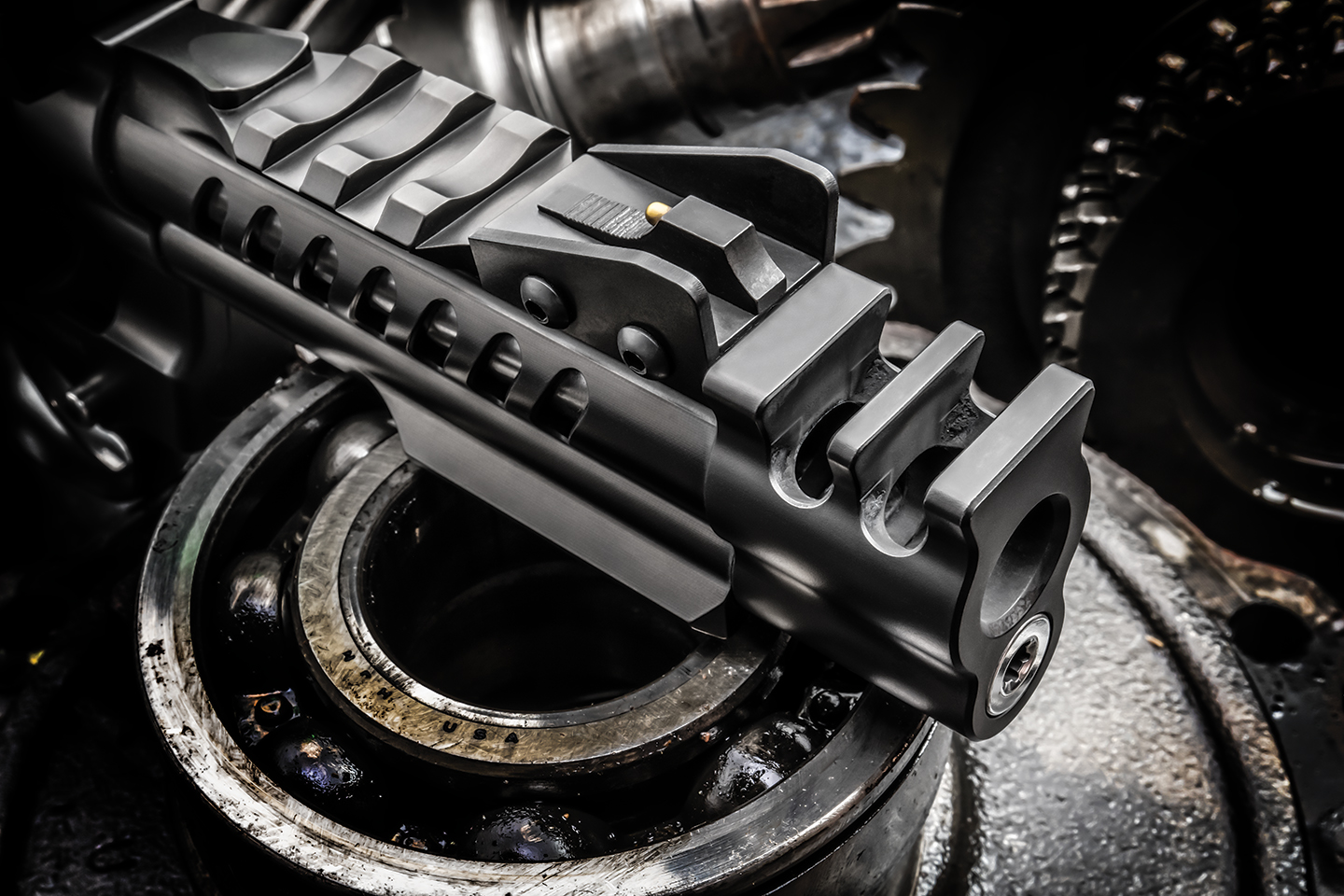
The stainless barrel is two-piece, its shroud covered with Pic rails top (for optical sights) and bottom (for light/laser attachments). At the front is a removable recoil compensator with two large upward vents so expanding gases can hold the muzzle down and bring the gun back on target more quickly in rapid fire, and steel baffles to catch those gases and drive the gun forward to counteract the rearward recoil impulse. Both work as intended.
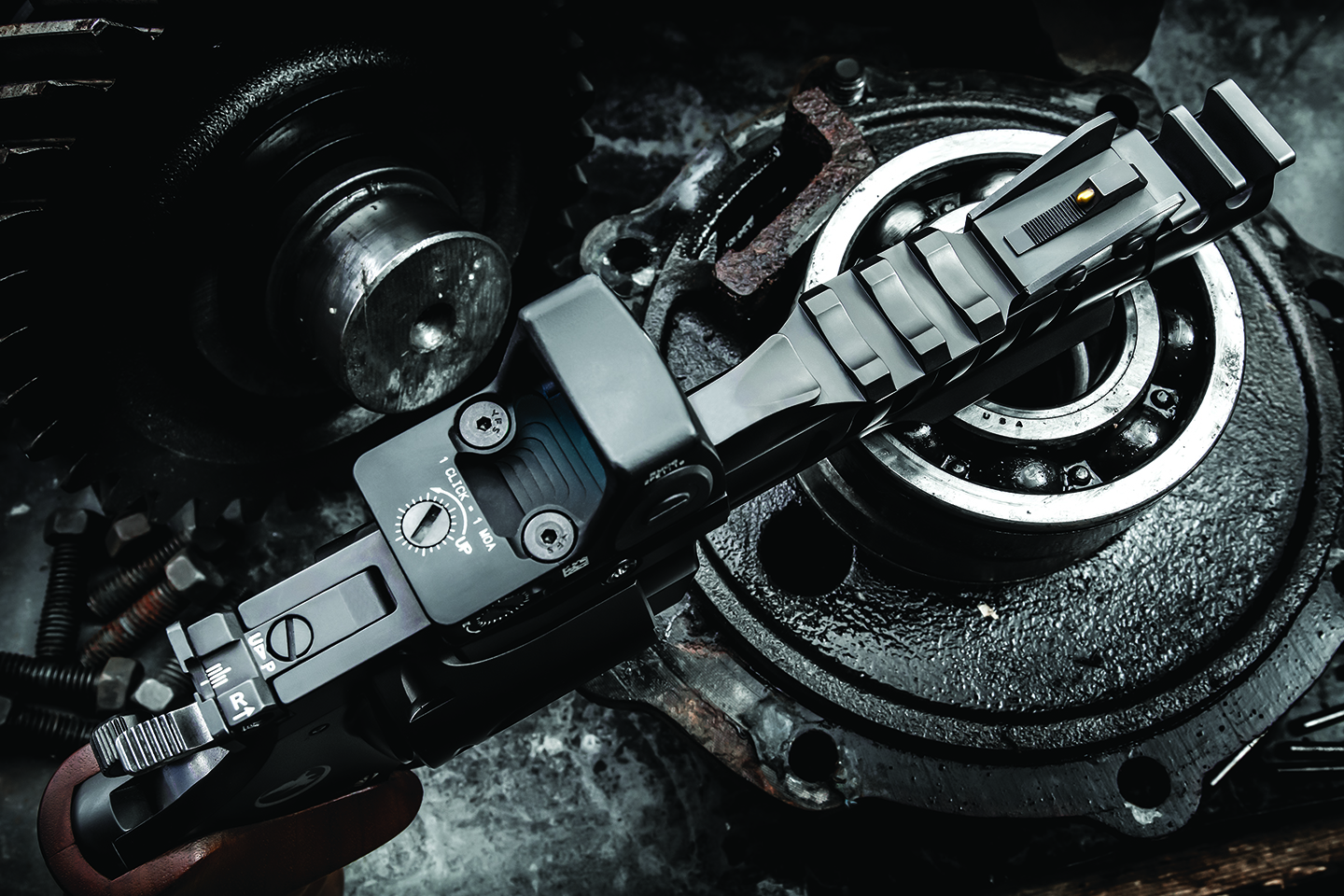
Sights are adjustable, serrated at the rear, and with a gold bead front protected by wings reminiscent of the old BoMar sight rib for PPC revolvers. The test gun also came with a Trijicon RMR carry optic.
Gun In Hand
Listed as having a four-inch barrel, our test gun is an inch longer due to the comp. Unloaded, it weighed 42.95 ounces on my calibrated scale, and in hand, the weight tended to settle forward. Out of the box, the trigger pull averaged 9.2 pounds double action and 3.64 pounds single action, a tad heavier than factory spec. The trigger face is ideal for DA shooting, being narrow and highly polished, and it’s equipped with an adjustable screw to prevent backlash, or trigger movement after the hammer begins to fall. Cylinder lockup is wonderfully solid, with barely perceptible play when the action is at rest and almost no palpable play when the hammer falls. It has its own “triple lock” system: the rear of the cylinder, the crane-to-frame, and the front of the ejector rod. The DA trigger pull is “different” in that it feels a bit heavier at the beginning of the stroke than at the end, but that sensation disappears the faster you shoot.
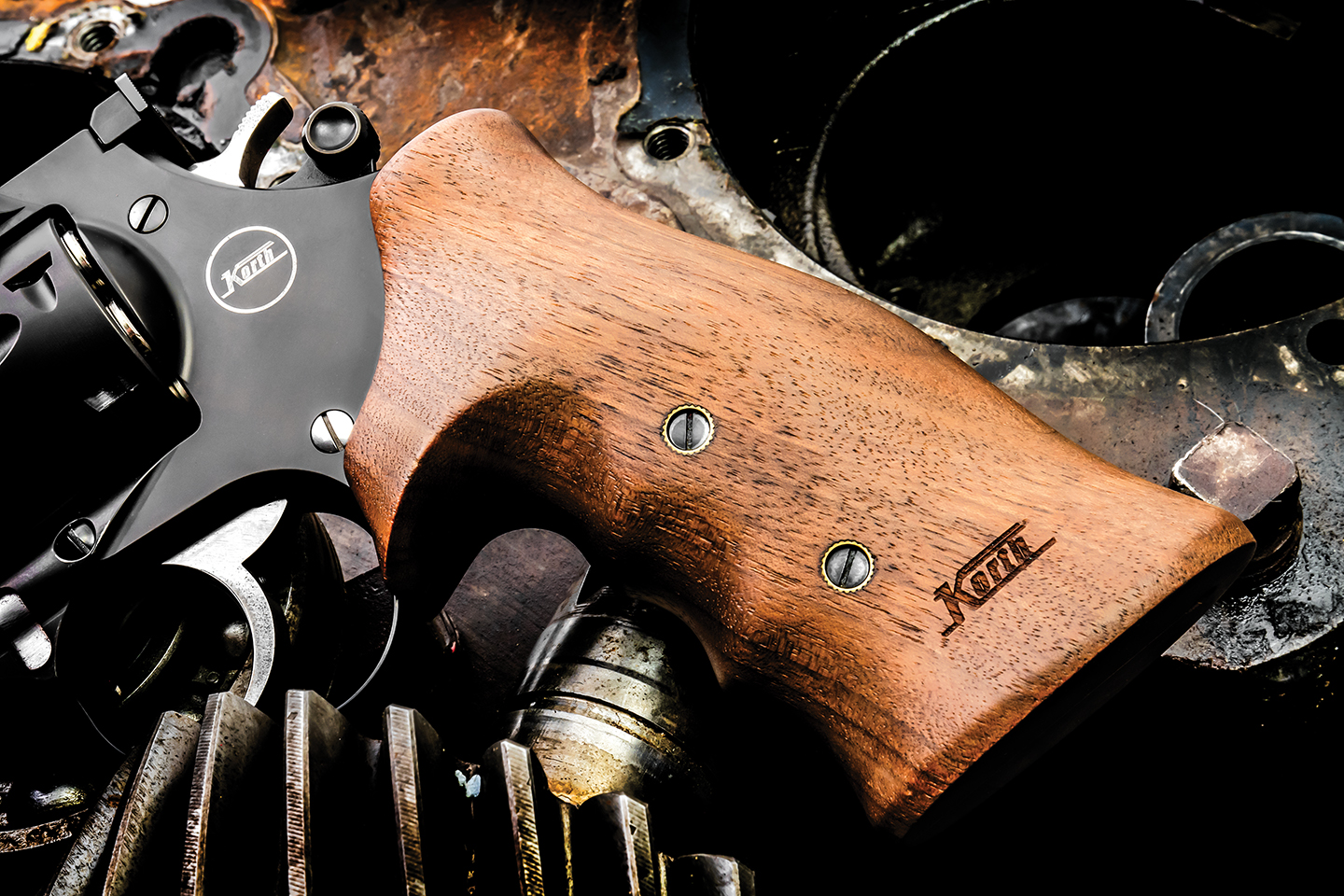
Recoil wasn’t bad at all, even with full-power Magnum loads in both 125 and 158 grain weights. The comp really works. The weight helps. The Turkish walnut grips are broad at the web of the hand, distributing rearward “kick” well.
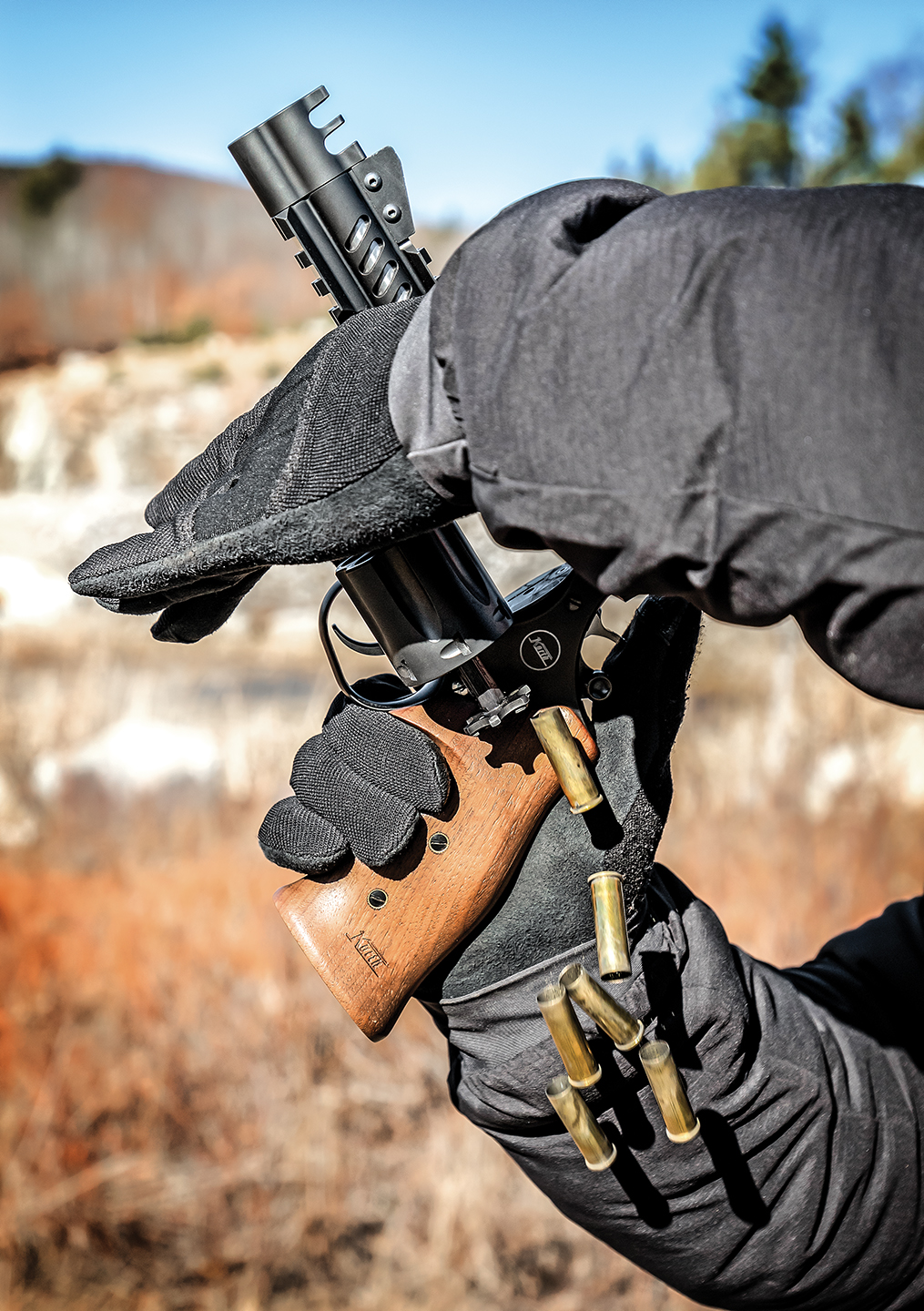
One ingenious feature is found in the accompanying 9mm cylinder assembly: while Nighthawk can sell you moon clips, you don’t need them to eject. As you press rearward on the ejector rod, the ejector star’s six tiny nubs catch in the extractor grooves of the 9mm casing and lifts them out. It sounds tenuous when I describe it, but it never failed to extract even a single spent casing in our testing.
Now, the finish: it’s a dark gray DLC (Diamond-Like Coating). Designed for utility more than beauty, it works, as evidenced by the fact that after a couple of thousand cylinder rotations in live and dry fire, there was still no “turn line” visible on the cylinder of our test sample.
Accuracy
Accuracy testing was my usual protocol: three different brands of ammo with the three most popular bullet weights in each caliber, fired in five-shot groups from a Caldwell Matrix rest on a concrete bench at 25 yards. Each group was measured center-to-center between the farthest-flung bullet holes twice: once with all five to test potential accuracy in experienced hands under ideal conditions, and again with the best three. The latter measurement factors out enough unnoticed human error to closely approximate what all five would have done from a Ransom machine rest. Most of our readers don’t have a machine rest, and this protocol is much easier for them to do themselves for comparison.
Revolvers convertible between 9mm Luger and .38 Special/.357 Magnum are sort of thin on the ground, but the general experience has been that the “revolver cartridges” are more accurate than the “auto cartridges,” the revolvers usually being bored and rifled for the former and the latter being slightly smaller in diameter. This Korth was my first such revolver to be the opposite: the 9mm grouped tighter than the .38 Special/.357 Magnum. The reason: bore diameter is .355” for the 9mm, with a 1:10 rifling twist. .38/.357 accuracy suffers only slightly because of the polygonal rifling, according to importer Nighthawk’s Landon Stone.
I used the iron sights, which apparently had been sighted in for the 9mm, which the gun delivered pretty much to point of aim/point of impact out of the box. 115-grain full-metal-jacket is the most commonly encountered 9mm Luger practice load and was represented here with the Remington/UMC brand. All five shots went into 1.60″ (I measure to the nearest 0.05″), and the best three measured 1.05″.
For a 124-grain we used MagTech round nose full metal jacket, which shot a 3.10″ group with all five, but (remember human error factor) only eight-tenths of one inch for the best three.
The 147-grain subsonic 9mm load, represented in this test by Federal HST +P jacketed hollow point, was the star of the accuracy show: every shot in 1.15” and the best three in 0.65”.
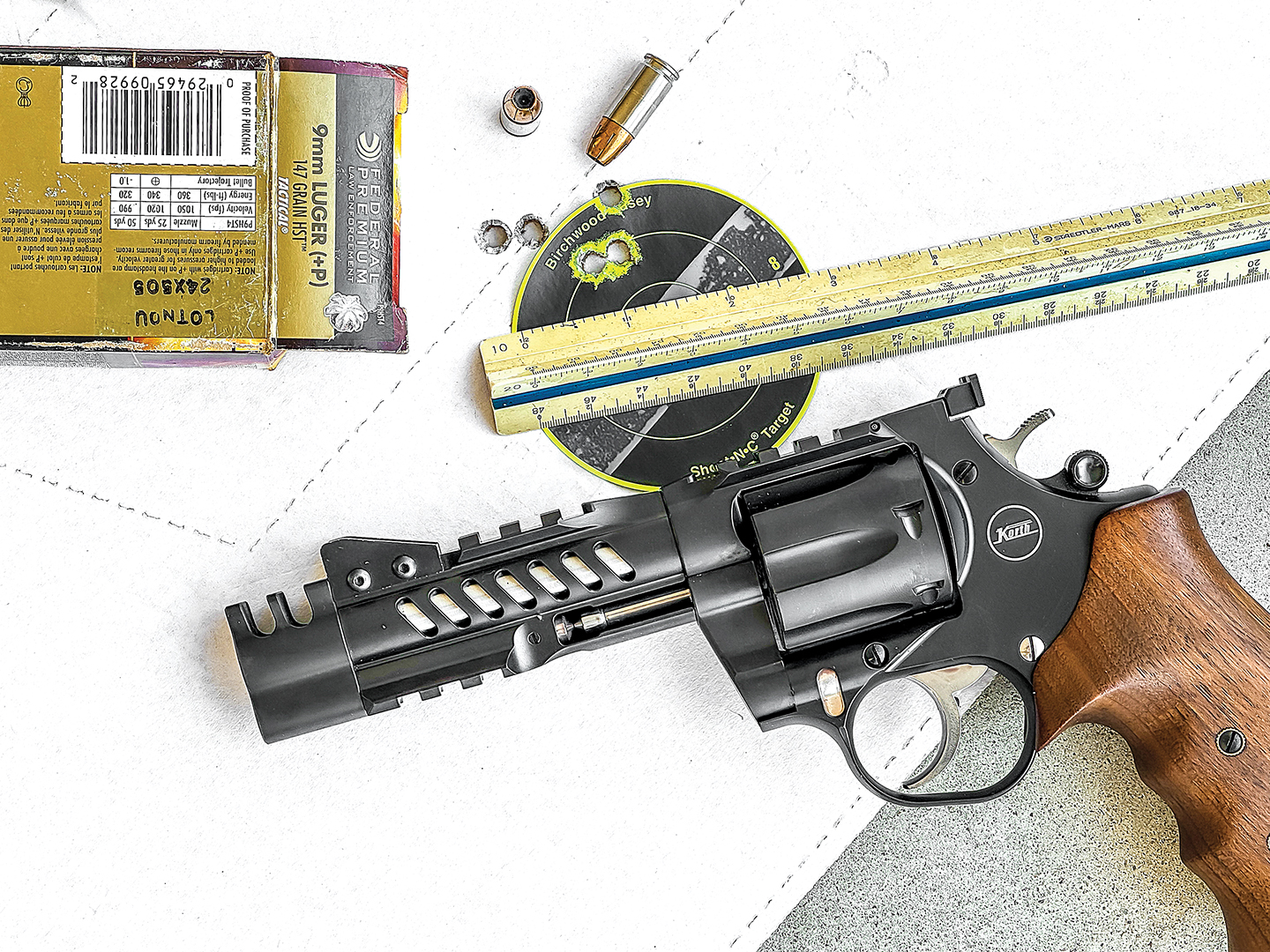
With the .38/.357 cylinder in place, we started with the most popular practice round these days for guns so chambered, a 130-grain round-nose full-metal jacket .38 Special, this box from Federal. The five-shot group measured 1.90″ and the best three, 1.30″. Sights had not yet been adjusted. This group, and the subsequent .38/.357 groupings, went high left.
The 158-grain round-nose lead .38 Special was, for much of the 20th Century, the load most often carried by both police and armed citizens. A called flyer stretched the five-shot cluster to 3.15″, but the other four went into 2.05″, and the tightest trio measured 1.10”.
The original bullet weight of full-power .357 Magnum was 158 grains, and it was represented in this test by MagTech’s semi-jacketed soft-nose load. The whole group measured a disappointing 4.60″, but the best three tightened up to 1.85″.
Throughout the test, with all ammo, the Ranger’s super-tight barrel/cylinder alignment produced perfectly centered firing pin hits, all decisively deep. Ejection was smooth and easy.
Perks and Quirks
The eight-person test team encompassed tall and short, male and female, lefties and righties, and ages ranging from the twenties to the seventies. Some Korth Ranger features received universal approval. We all appreciated the light recoil, especially with .357 Magnum rounds. We all found the forward-rocking cylinder release lever next to the hammer to be faster for reloading than the typical American revolver with a left-side cylinder release latch. It also made the gun more southpaw-friendly. Everyone shot well with it, especially double action. Most liked the sights, though firearms instructor Steve Denney would have preferred a fiber-optic front and champion IDPA revolver shooter Allen Davis, a plain black, serrated front post. We all appreciated its 100% reliability. The excellent workmanship and “class” were appreciated by all. So was the adaptability to cheap 9mm practice ammo, and its accuracy therewith. Champion shooter and retired big-city police instructor Kevin Williams expects it’s good for a 2.5-3 second Bill Drill.
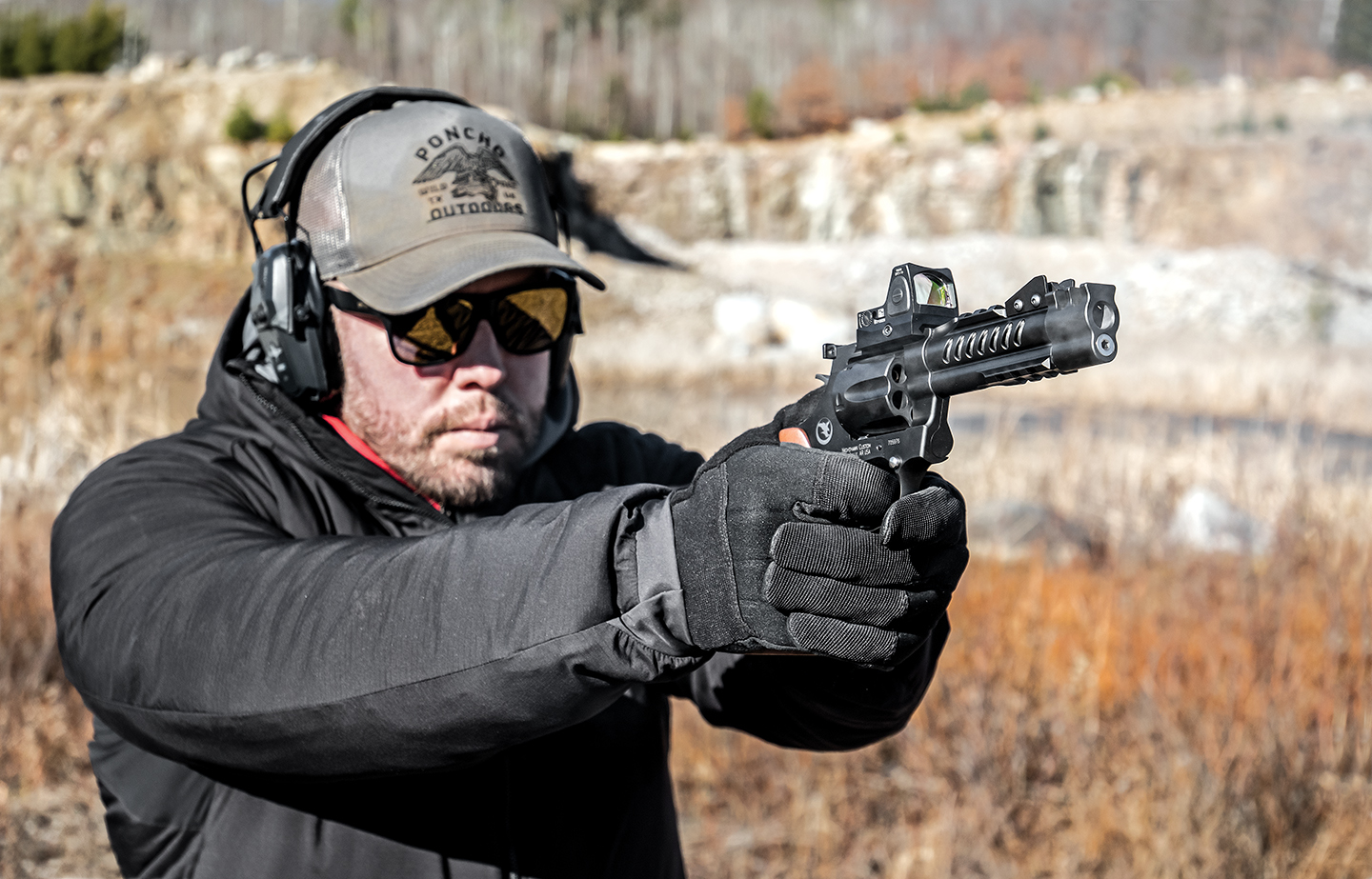
The cylinder release lever placement didn’t exactly get in the way of single-action thumb cocking, but didn’t go unnoticed either. The price as tested is a whopping $7700 or so, thanks in part to recent tariffs. That’s $5,224 for the Ranger, $1,499 for the extra cylinder assembly, $699 for the Trijicon, and $275 for the comp. This is the kind of gun that goes well in the console of a Mercedes-Benz. Value is a subjective thing. But so are prestige and pride of ownership, and the Korth most certainly delivers those along with its accuracy, versatility, and impeccable build quality. See the Korth line at your nearest dealer, or for more information, contact Nighthawk Custom; Tel.: (870) 423-4867; E-mail: [email protected]; Web: www.nighthawkcustom.com.
Specifications:
Action: Double/single action
Caliber: .357 Mag./.38 Spl./9mm
Barrel Length: 4.0
Width: 1.54 inches
Height: 6.10 inches
Weight: 38.72 ounces
Finish: DLC Black
Sights: Picatinny rail, adjustable sights
Capacity: 6 rounds
Base MSRP: $5,224