


Wilson Combat Division 77 Project 1
By Massad Ayoob
1”/75’ accuracy, great street trigger, zilch recoil for 19 rounds of 9mm +P… it’s worth the price.
“Division Seventy-Seven Project One.” That’s a long name for a pistol, eleven syllables before you even get to the manufacturer’s name.
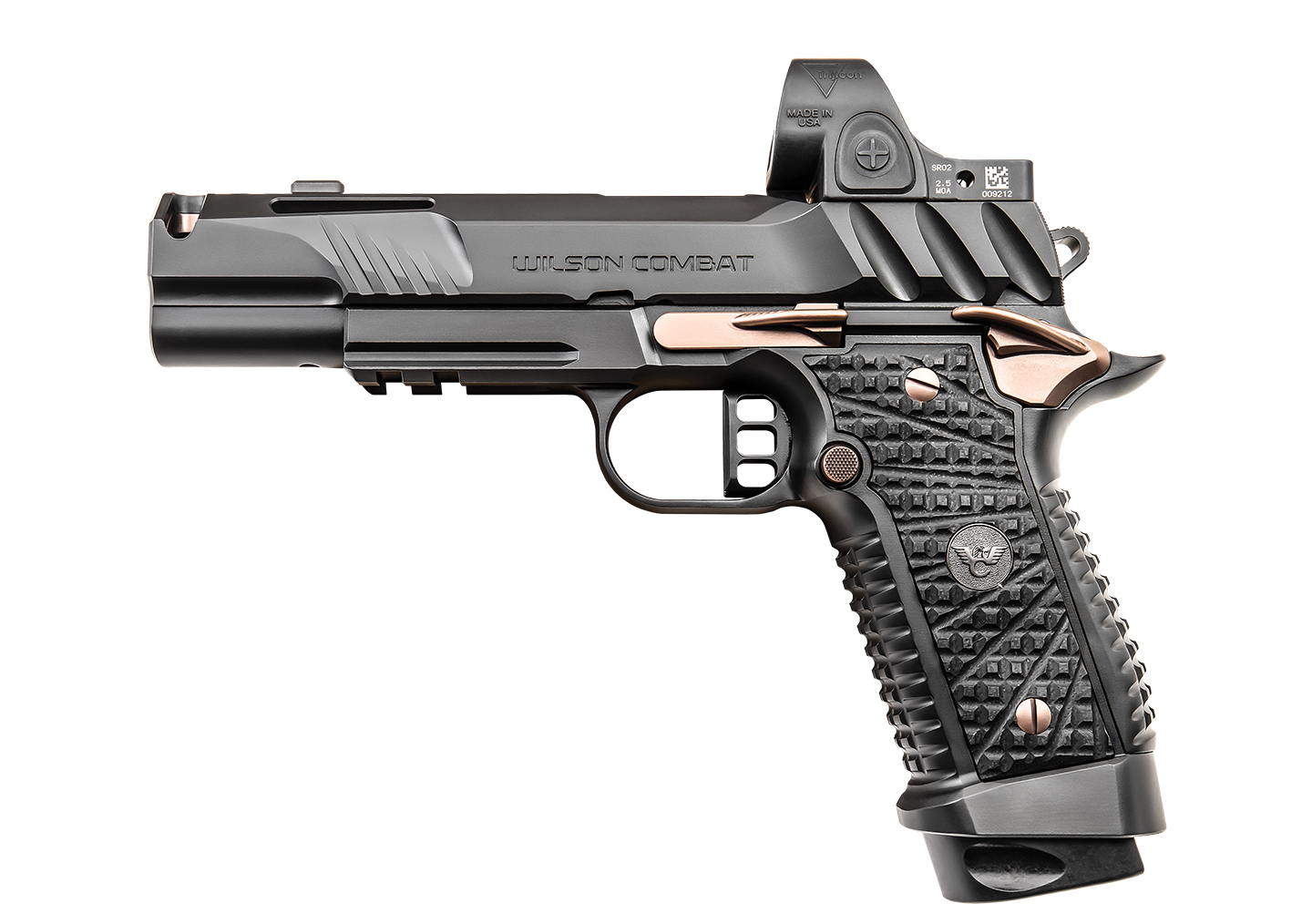
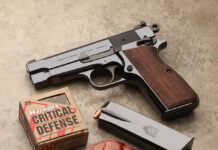
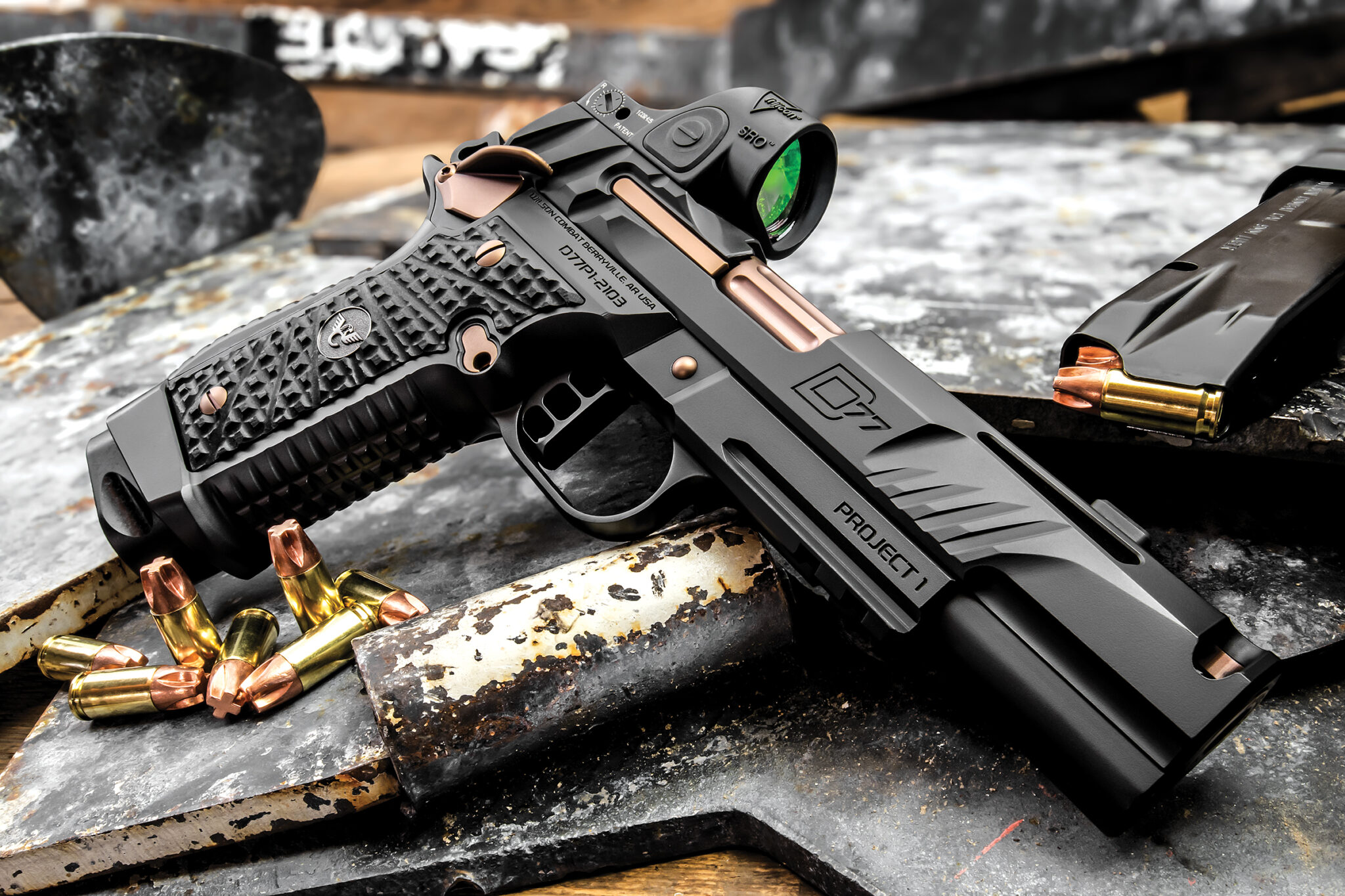
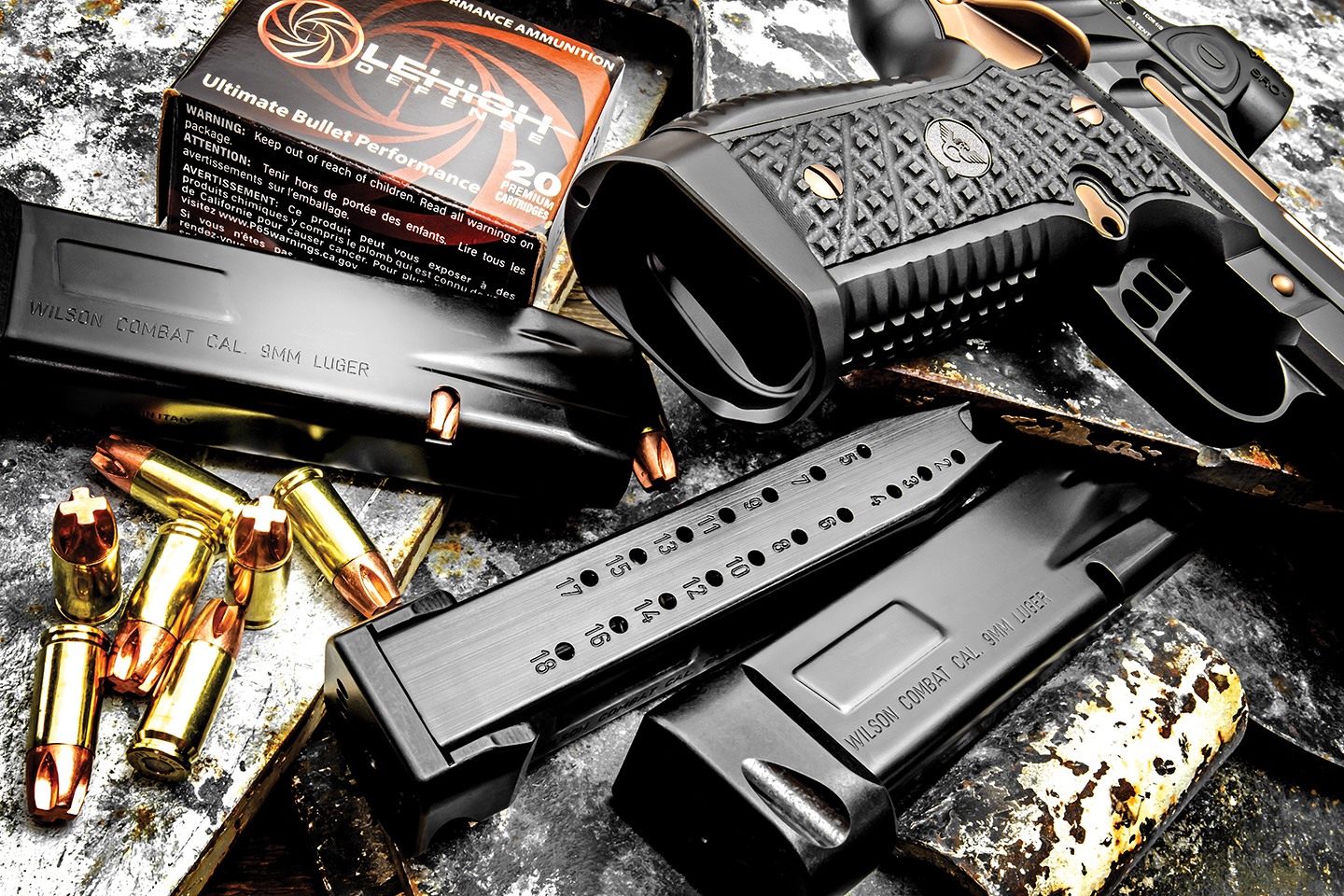
Heck, it’s almost as long as the list of features for this pistol. Magazines that hold 18 rounds of 9mm inside a rounded grip frame that’s more ergonomic than any of the squarish 2011s I’ve seen on the market. A direct-mount optics system that does away with troublesome plates. A recoil compensator, which the manufacturer promises, reduces muzzle rise by 42%. Ambidextrous safety properly adjusted for both “on” and “off,” and no grip safety to worry about at all. And the famous Wilson Combat trigger pull, about which more soon. The frame is aluminum to make this big, five-inch barrel pistol reasonably light, and, of course, the now almost obligatory light/laser mounting rail built into the dust cover of the frame.
Backstory
I interviewed Cam Ankele (pronounced “Ankly”), who became the Chief Operating Officer of Wilson Combat after its founder, Bill Wilson, retired. He explained the unusual name of this pistol. “Division 77 is our research and development section, named after the year Bill started the company. Its purpose is to develop things that haven’t been done, or at least, haven’t been done with maximum effectiveness,” Ankele told On Target.
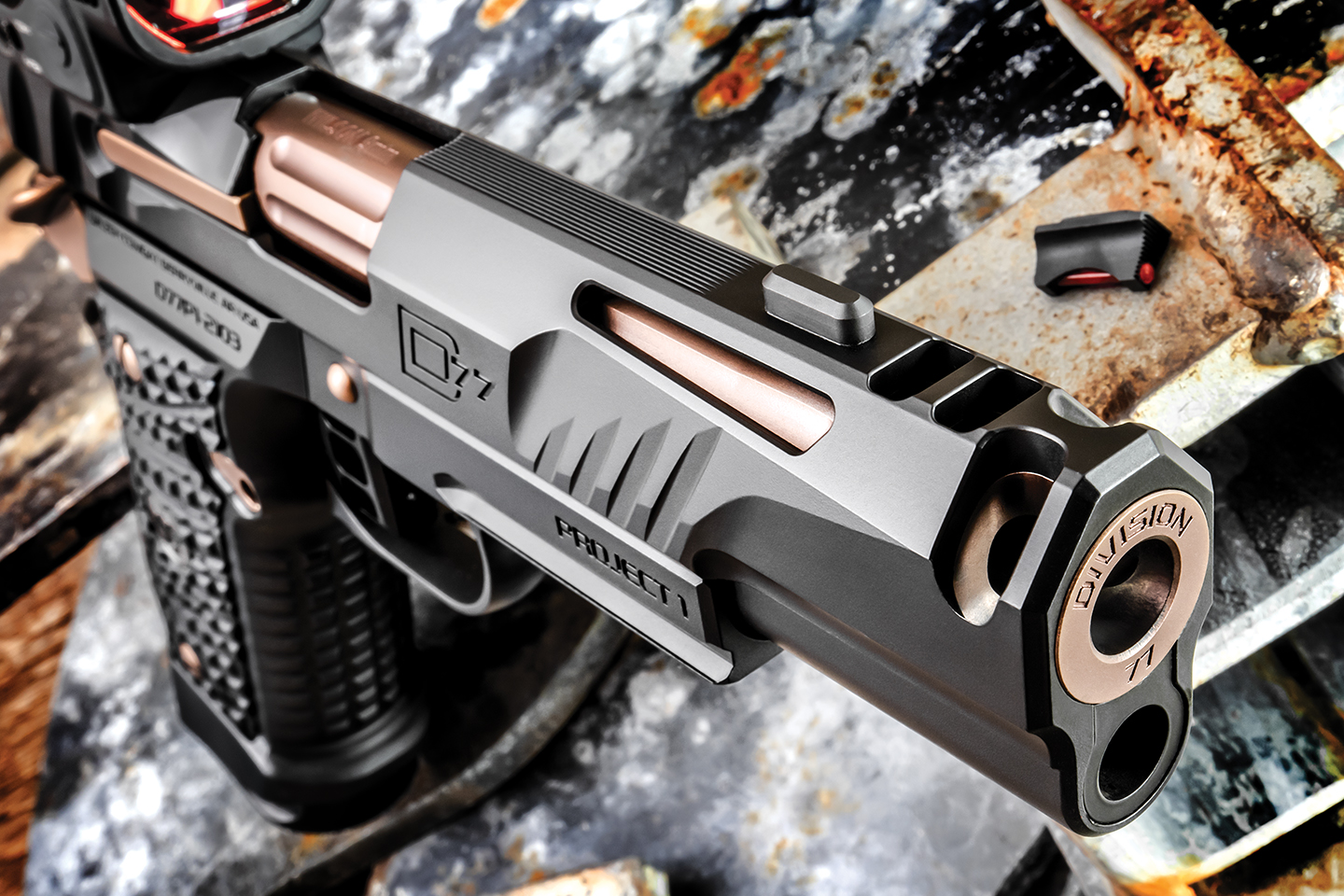
Ankele added, “We have a patent pending on our Accucomp system, which is built into the barrel. We have another patent pending on our full-size guide rod. We’ve all worked with full-length guide rods that locked guns up; we wanted quick removability along with reliability. We call it the RPG guide rod because it’s in the shape of a rocket-propelled grenade. It’s one-piece and easier to remove because of its shape.”
On the Range
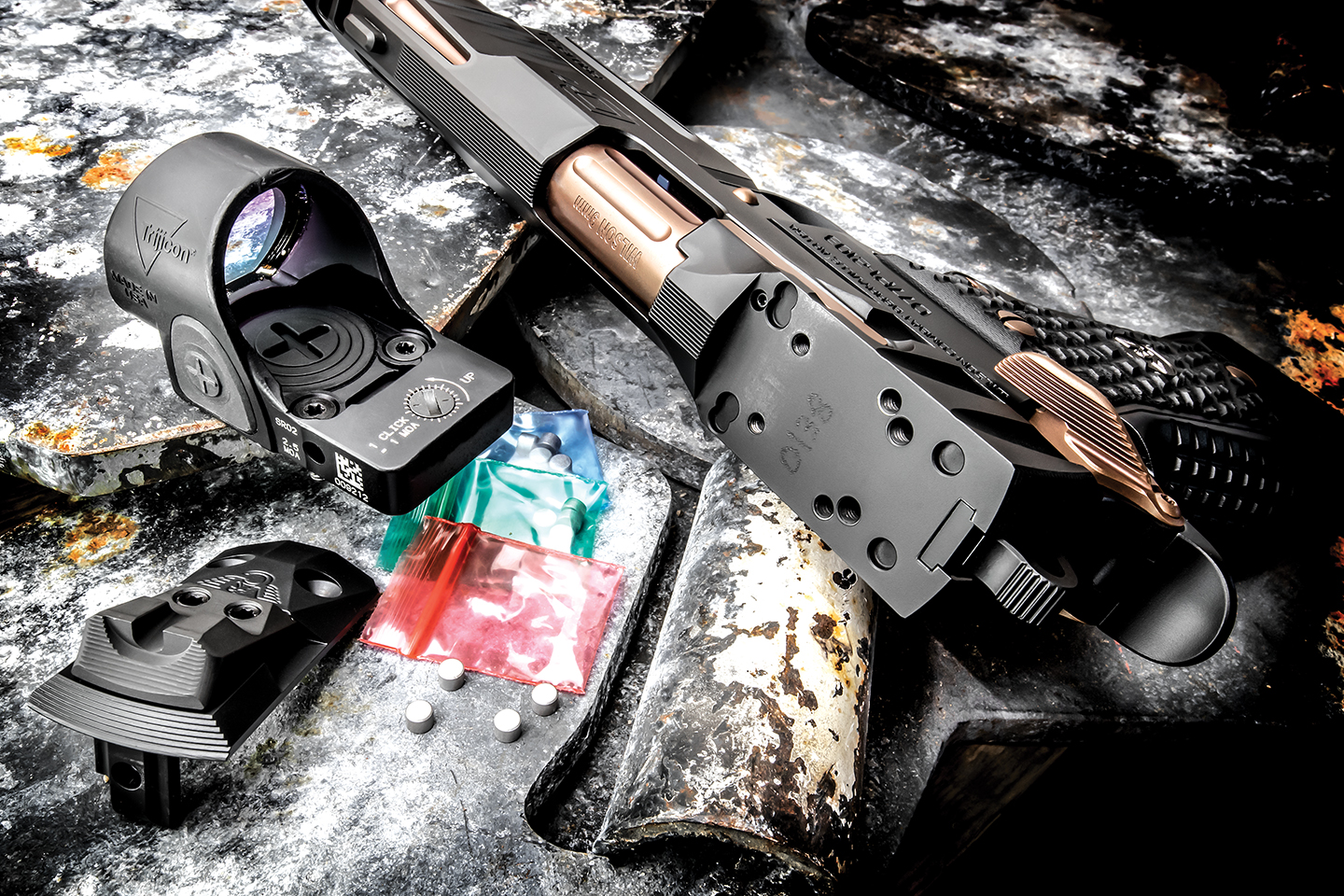
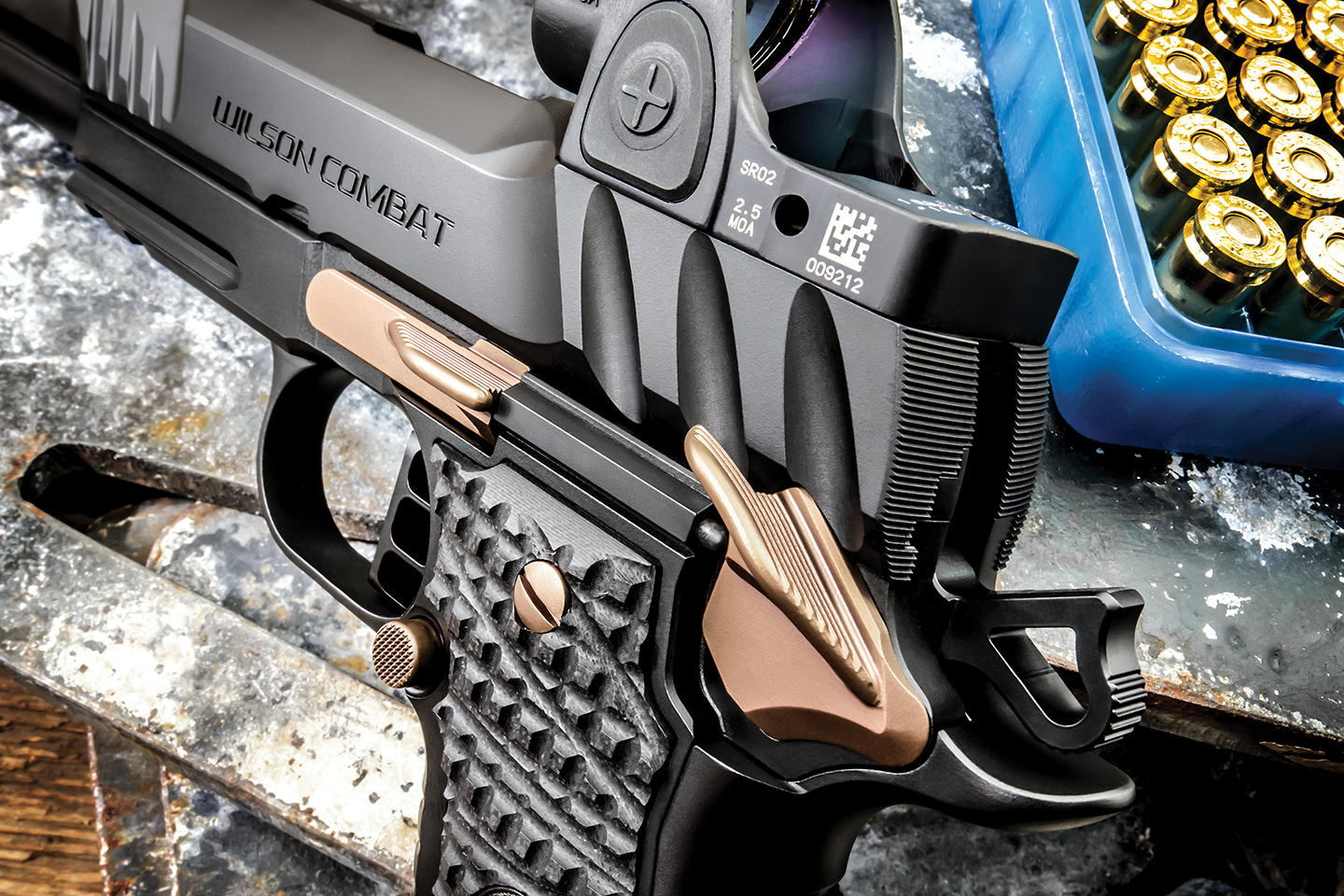
This pistol has the TRAK pattern that proved so popular on earlier EDC X9 series Wilson Combat pistols. As seen in the photos, the large squares all around have enough space for the flesh of the hand to sort of flow between them, locking the pistol in a solid grasp without digging uncomfortably, as some forms of stippling do. Long shooting sessions with it won’t make your hand hurt afterward, no matter how hard you’ve grasped Division 77 Project 1.
As noted earlier, Wilson guns are famous for their good trigger pulls. Note that “good” in this context doesn’t mean “light” so much as it means “smooth and consistent with a crisp break.” The Lyman digital trigger pull gauge averaged 4.24 pounds: ideal for a gun that might be used for self-defense, since 1911 armorer’s school recommends 4.0 pounds as a red-line minimum for a “duty” (read: self-defense) pistol that might be pointed at human beings under stress.
When the trigger breaks cleanly on this pistol, there is no undesirable “backlash” (rearward movement after the sear releases), and the reset of the trigger is extremely quick. All good for fast, accurate shooting.
The entire pistol is well-adjusted: the thumb safety is “just right,” the magazine release works flawlessly, and the humongous magazine well makes insertion of fresh magazines super-easy. Trigger reach is such that my petite wife could get the pad of her short finger onto the flat-faced trigger easily, while I was able to get my preferred finger placement at the distal joint for greater leverage.
Accuracy
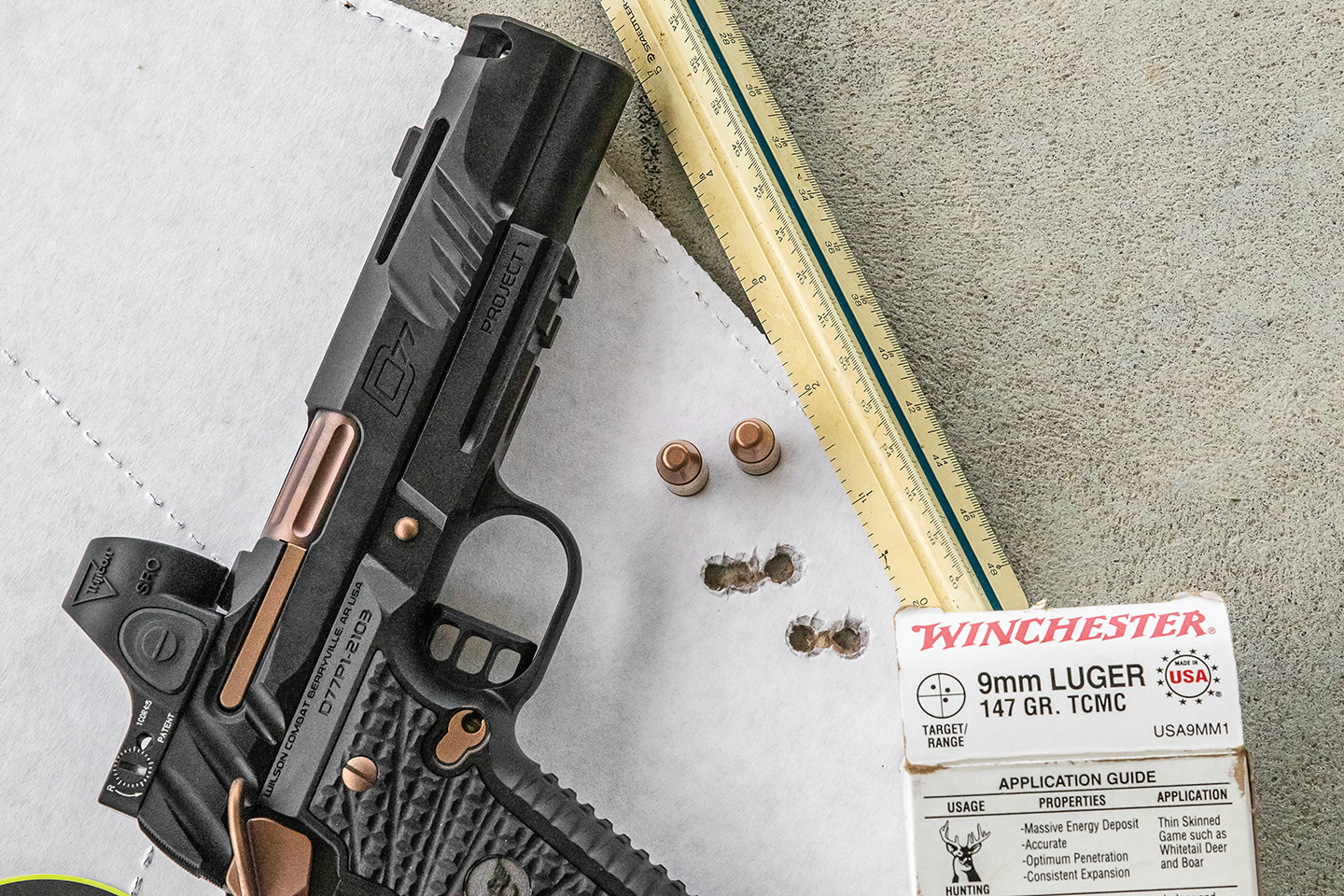
Wilson Combat guarantees one-inch groups at 25 yards. That presumably comes from testing in a machine rest, a device most of our readers don’t own, so I test with something easier for readers to replicate on their own: five-shot groups fired from a bench rest at 25 yards, measured once for all five hits (replicating predictable performance by an experienced shooter under ideal conditions) and again for the best three, which testing has shown roughly equals what all five would have done from a machine rest.
Off a Caldwell Matrix rest on a concrete bench, 147 grain subsonic Winchester jacketed truncated cone was the most accurate, with a 1.20″ for all five shots and right at half an inch, 0.50″, for the best three. This measurement was center to center between the farthest-flung bullet holes measured to the nearest 0.05″. 124-grain +P Speer Gold Dot measured 1.55″ for the tightest trio, and Federal’s famously accurate 115-grain standard pressure JHP went under an inch, 0.90″, for best three. Wilson Combat doesn’t lie about the accuracy.
A long-standing truth about 1911 pistols: you can get a tight one that’s accurate but finicky about reliability or one that rattles and doesn’t shoot one-inch groups but runs reliably. To get both, you need something like a Wilson Combat, and you have to pay for the kind of workmanship that delivers that rare combination. The Division 77 Project 1 delivers on accuracy and reliability together.
And, as a bonus, smoothness. Working the action, you feel a pleasant and satisfying smoothness. In-house gunsmiths at WC make sure everything, from the springs to the (in this case, ambidextrous) thumb safety, works just right in terms of positivity and smoothness.
Reliability? We shot it with steel case, nickel case, and brass case, 115 grain to 147 grain, round nose FMJ, and jacketed truncated cone, and hollow point, standard pressure, and +P, and +P+, and NATO spec. As expected, it fed and cycled 100%.
Perks and Quirks
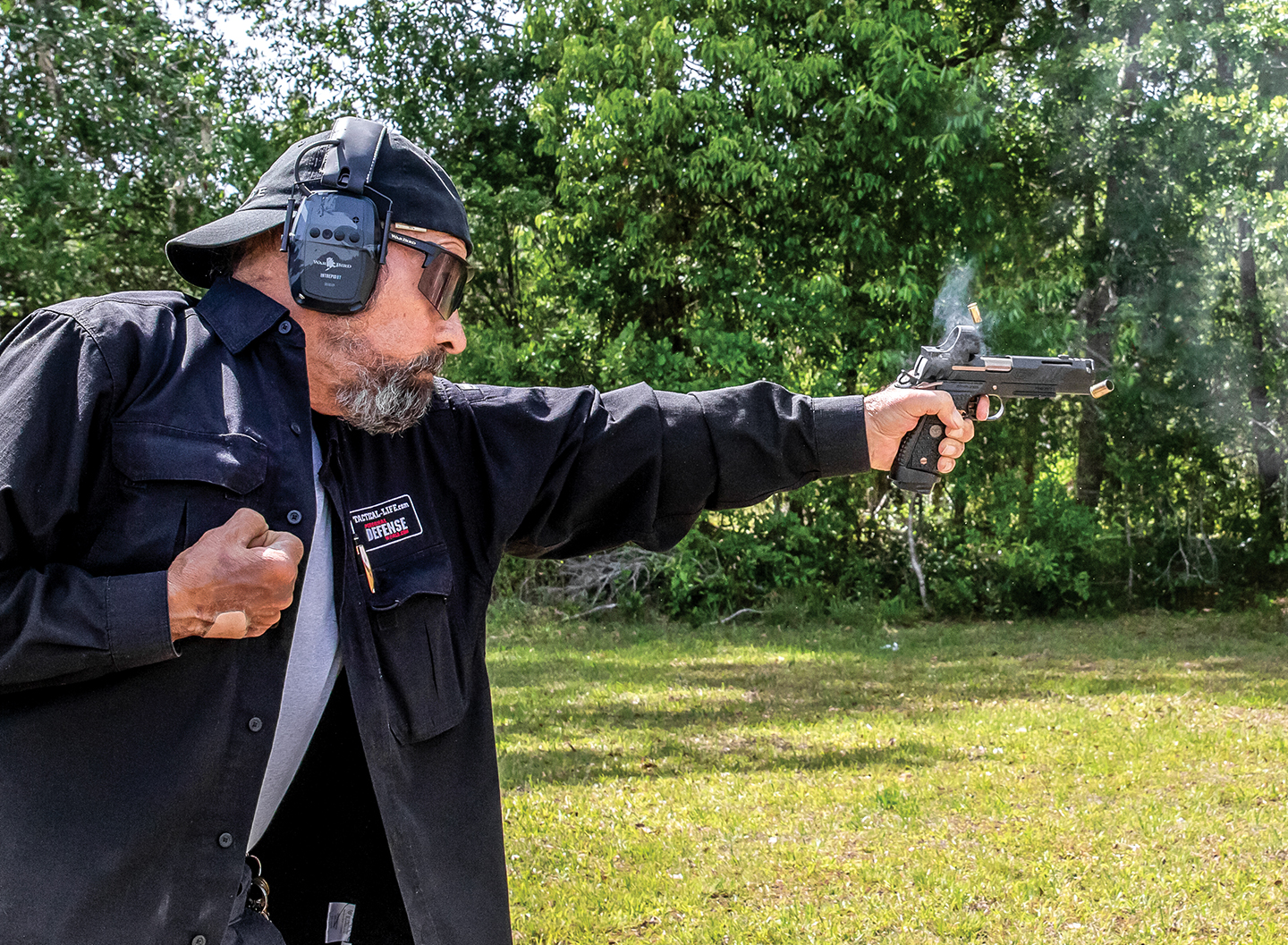
I can’t parse it finely enough to attest to the 42% muzzle rise reduction, but I can tell you that in flat-out rapid fire, the red dot of the Trijicon SRO, one of my favorite carry optics, simply danced around the point of aim. When I looked at the pictures and saw the gun still on target when my elderly body was shooting one hand only, and there were three pieces of brass in the air around the gun, it told me the muzzle stayed down and the pistol “shot flat” pretty much as Wilson Combat promised.
The pistol is clearly living up to Wilson Combat’s promise of one-inch at 25-yard accuracy with the ammo the gun likes most. It was, overall, a pleasure to shoot.
Quirks? The copper-colored PVD coating on the barrel, slide stop, grip screws, external extractor, and thumb safety levers is for style only and doesn’t bother me, except for being on the safeties. In self-defense situations, one life-saving advantage of the 1911 design has been that when a Bad Guy gets the gun away from a Good Guy, it’s beneficial not to have a contrasting color indicating to the opponent, “Hey, here’s the switch that turns on the gun you just grabbed.” (And yes, I recognize that’s pretty picky.)
Wilson Combat says their direct mount can adapt to 90% of the carry optics out there. What came with the SRO did not allow for backup iron sights. Some of their other options should.
The test gun came to me from On Target with the SRO sight already mounted. From the height of the carry optic to the floorplate of the 18-round magazine measures about seven inches. So equipped, that makes it challenging (though do-able) for concealed carry. I see this as more of a competition pistol, an openly carried duty sidearm, or a home defense handgun.
Of course, there’s also the base price: $3,995 suggested retail. You don’t pay that much for a pistol unless you want or even need its high performance, not to mention the prestige and pride of ownership factors. On all those elements, Wilson Combat has historically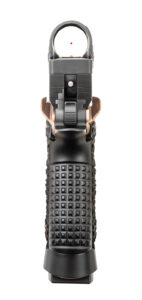 delivered.
Division 77 Project 1 lives up to that history. Cam Ankele promises that subsequent projects will be unique and not variations of earlier models. We’re eagerly looking forward to what comes next. See the Division 77 Project 1 pistol at your nearest Wilson Combat dealer, or for more information, contact Wilson Combat; Tel.: (870) 545-3618; Web: www.wilsoncombat.com
Specifications:
Action: Single action
Caliber: 9mm
Barrel Length: 5.0 inches
Overall Length: 8.7 inches
Width: 1.4 inches
Height: 5.5 inches
Weight: 33.8 ounces
Finish: Black Armor-Tuff/copper PVD
Sights: Project 1 optic pin system, fixed sights
Capacity: 18+1 rds.
MSRP: $3,995